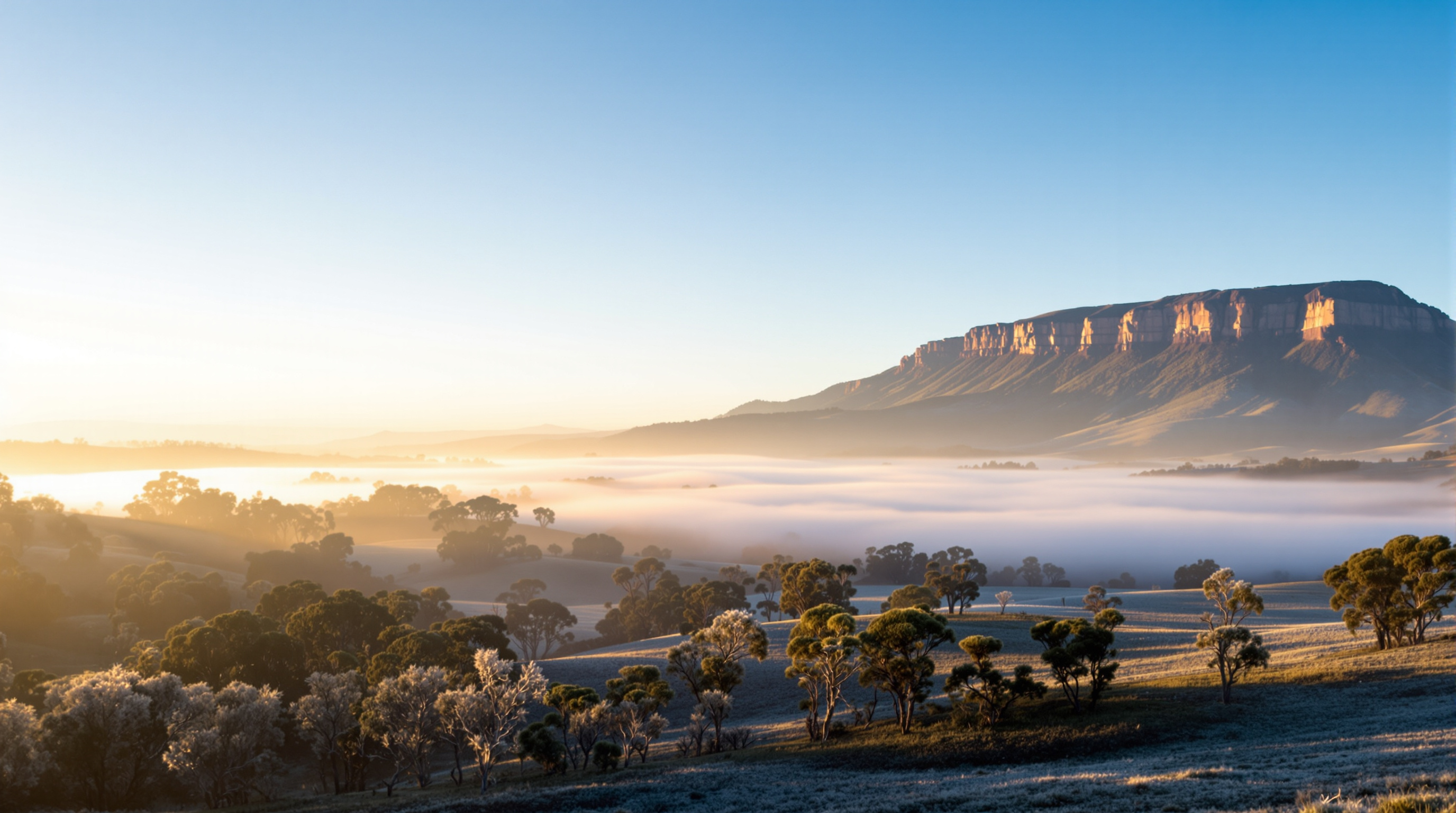
The minutes around sunrise and sunset invite a quieter landscape photograph. Begin with the shape of the land, decide how much detail the picture needs, and let the changing light guide the next frame.
Sunrise and sunset, precisely
In Geoscience Australia's astronomical definitions, sunrise and sunset occur when the upper edge of the Sun's disk meets an ideal horizon, under ideal meteorological conditions and with standard refraction. The definition uses the upper edge of the disk; the twilight boundaries use the Sun's centre. Keeping that distinction in mind makes the sequence easier to understand.
For a photograph, treat sunrise or sunset as a reference point within a session. Before making an exposure, decide what belongs in the frame: a ridge against the sky, a waterfall within its gorge, or a small foreground detail. Give the composition a purpose before choosing its brightness.
A useful exercise is to sketch the intended arrangement in a notebook: horizon, main shape and an area left empty. Return to that arrangement when reviewing frames. If the scene asks for a different picture, make the change consciously and begin another sequence, so the comparison still has a clear purpose.
Civil twilight: the working window
Morning civil twilight begins, and evening civil twilight ends, when the Sun's centre is 6° below an ideal horizon. At that boundary, without moonlight, artificial lighting or adverse atmospheric conditions, large objects can be seen but detail is not discernible. The brightest stars and planets can be visible. Those qualifications matter when translating a formal definition into expectations for a scene.
For blue-hour work, use the civil boundary as a planning reference and inspect the picture itself. Does the foreground need texture, or would a simple outline say enough? Make a frame that favours the sky, then reconsider the foreground. Choose deliberately which part carries the photograph, rather than trying to give every tone equal importance.
When reviewing a frame, look first at its smallest version. Ask whether the main shape remains readable without enlargement. Then inspect the detail needed for that particular composition. Use both views to decide whether to adjust the exposure, simplify the frame, or wait.
Nautical and astronomical twilight
The corresponding nautical boundary occurs at 12° below an ideal horizon. Under the same qualifications, it is dark for normal practical purposes, and the sea horizon is not normally visible. At the astronomical boundary, 18° below an ideal horizon, scattered sunlight contributes less illumination than starlight and other natural light sources in the sky. These are defined solar positions.
Keep the angles separate from camera settings. The useful question is what the intended photograph requires: a clear silhouette, a readable middle distance, or detail across the whole composition. Review that requirement as the scene changes. A frame can be successful without describing everything that was in front of the camera.
Cold, clear mornings on the plateau
The Bureau of Meteorology's Armidale climate statistics provide long-term averages from one station, Armidale (Tree Group Nursery), at an elevation of 987 m. Its temperature record begins in 1997. The mean minimum is -0.2 °C in July and 0.1 °C in August. These figures describe that station's climate; they are not a forecast for a particular morning or a measurement at a gorge viewpoint.
Use that context to make preparation part of the composition. Arrange clothing and camera access before settling into position. Choose a simple starting frame and practise reaching the controls needed for it. Leave room in the plan to shorten the session when conditions make careful work difficult.
Rehearse a small set of decisions before the visit: where the camera will rest while waiting, how the frame will be reviewed, and what would prompt a return. Keep attention available for looking rather than searching through the bag.
Choosing a season
At the same single Armidale station, long-term clear-day and cloudy-day averages cover 1997–2010. Mean clear days are highest in September at 13.4, followed by August at 12.8. November has the highest mean number of cloudy days, 12.5. The station's long-term mean rainfall is 92.7 mm in November and 92.8 mm in February. These averages provide seasonal context without predicting a particular sky.
Choose a visual intention alongside the season. One session might explore a spare skyline; another might concentrate on the relationship between water and rock. Prepare an alternative composition that does not depend on the expected sky. Judge the visit by the attention given to the scene and the strength of the selected frames.
Escarpment and gorge viewpoints at first light
NSW National Parks describes Oxley Wild Rivers National Park near Armidale as part of the Gondwana Rainforests of Australia World Heritage Area, with dry rainforest, gorges and waterfalls. Its Apsley Macleay Gorges are among Australia's largest gorge systems. Treat that scale as a compositional question: which single shape should anchor the photograph?
New England National Park, in the Northern Tablelands, is also part of that World Heritage Area. NSW National Parks highlights its snow gum forests, Great Escarpment views and sunrises. Consider whether the frame should emphasise a foreground tree or the larger view. Check conditions with NSW National Parks before setting out, use established access, and stay behind lookout barriers.
A simple twilight routine
Choose a position and compose before experimenting with exposure. Inspect the corners, decide where the horizon belongs, and identify the brightest area that matters. Make a starting frame, review it, then change one choice at a time. Reconsider focus and brightness as part of that review, rather than assuming the first decisions will suit the whole session.
Keep a short sequence from the same position for comparison. At the desk, ask which frame has the clearest structure, which handles the foreground most deliberately, and which needs the least explanation. Select for the picture's purpose. The broader guides to light and composition and landscapes of the Tablelands offer further ways to practise those decisions.