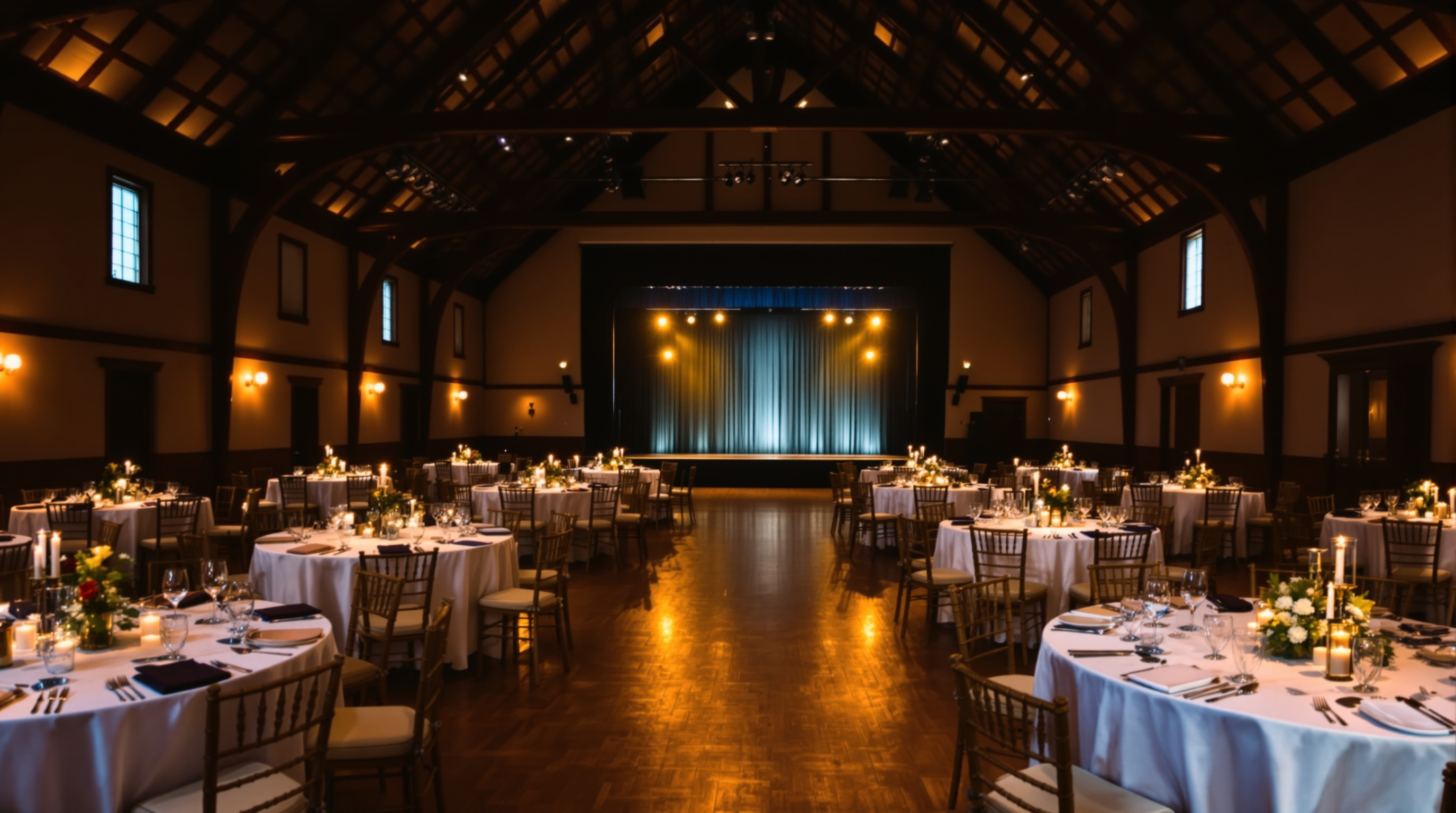
Event photography looks like a matter of quick reflexes. In practice it is a matter of preparation, position and restraint — the reflexes are the smallest part.
Formal occasions, graduations, concerts, community celebrations and civic gatherings all share a structure: a long build-up, a short peak, and a wind-down. The photographer's job is to be invisible during the build-up, perfectly placed at the peak, and generous through the whole of it. Everything below is in service of that.
Before the event: the real work
Most of the outcome is decided before anyone arrives. A good event photographer learns the running order, walks the space, and finds the two or three positions from which the key moments can be made without disruption. Where will the light come from as the afternoon turns to evening? Where is the presentation, the entrance, the toast? Which background is clean and which is cluttered? Answering these questions in advance turns a chaotic evening into a series of anticipated frames.
Working the room discreetly
The best event coverage barely registers with the people in the room. That means:
- Dressing to disappear — matching the occasion so the camera, not the photographer, is the only unusual thing present.
- Moving at the edges — travelling around the perimeter and pausing, rather than cutting through the middle of gatherings.
- Using available light where possible — a single well-placed on-camera flash is sometimes unavoidable indoors, but constant flash makes people self-conscious and flattens the atmosphere. Learning to work at higher sensitivities and wider apertures keeps the mood intact.
- Shooting in short, calm bursts — a few considered frames, then a pause to watch, rather than a continuous machine-gun rattle that puts everyone on edge.
Anticipating the peak moment
Every event has moments that will only happen once: the handshake, the cap thrown, the first dance, the ribbon cut. These cannot be repeated for the camera without becoming false. The skill is anticipation — watching body language and the running order closely enough to have the frame composed and the focus set before the moment arrives. Photographers often speak of Henri Cartier-Bresson's idea of the decisive moment; in event work that moment is rarely a surprise, which is exactly why preparation beats reflex.
Respecting the people in the frame
Events are made of people who did not necessarily come to be photographed. Good practice means reading consent from the room, avoiding unflattering frames even when they are technically strong, and never making a subject the butt of an image. In community and youth settings especially, discretion and good manners matter more than any single picture. The International Center of Photography's writing on documentary ethics is a good grounding for anyone doing this work seriously.
After the event: editing down
A three-hour event might produce hundreds of frames and perhaps forty keepers. The discipline is to deliver the forty, not the hundreds. Ruthless editing — cutting blinks, duplicates, and the merely competent — is what separates a professional-feeling set from an exhausting one. The photographer who edits hard is trusted; the one who delivers everything makes the viewer do the work.
A note on backups and delivery
The unglamorous end of event work is where reputations are quietly kept or lost. Irreplaceable frames deserve to be copied to two places before the night is over, because an occasion cannot be re-shot. Delivery matters too: a clearly organised, sensibly sized, well-titled set says as much about professionalism as any single image. The best event photographers treat the handover — the naming, the sequencing, the safe archiving — as part of the craft, not an afterthought to it.
The through-line
Event photography, at its best, is quiet service: being present, prepared and respectful so that a community keeps an honest record of its own occasions. For the human side of that record, see photographing community and civic life; for the technical foundations, see light and composition.