Short, dated notes from the practice of photographing the high country — weather, light, and the small lessons a season teaches.
On highland weather
The single most useful habit for a New England photographer is reading the sky the evening before. The plateau's altitude means clear nights radiate heat fast, and clear mornings often begin with valley fog that burns off within an hour of sunrise. That hour is the prize: mist in the gullies, a low sun, and a softness the middle of the day never offers. Checking the Bureau of Meteorology forecast for overnight minimums and dew point is a more reliable planning tool than any photographic app.
On autumn colour
Unusually for inland Australia, the New England towns carry strong European autumn colour through the cooler months, planted over generations along the streets and in the parks. It is a brief, well-loved window. The craft lesson is restraint: autumn colour tempts the eye into busy, saturated frames. The stronger pictures usually isolate one tree or one avenue against a plain sky or a shadowed background, letting the colour do its work without competition.
On working through the seasons
Frost mornings, dry golden summers, the green flush after rain — each season rewrites the same locations. A gorge lookout that is hazy and flat at noon in January can be spectacular under winter's raking side-light. Returning to the same places across a year, in different weather, teaches more about light than travelling to new ones. It is the discipline behind almost every serious body of landscape work in collections such as those of the National Gallery of Australia.
On editing after the fact
A productive day in the field produces a hard evening at the desk. The temptation is to keep too much. The habit worth building is the opposite: choose the two or three frames that genuinely say something, and let the rest go. A small, strong set of images is worth far more than a large, tired one — a principle explored further in the featured essay.
On carrying less
A recurring lesson from the plateau is that a lighter kit produces better pictures. The temptation to pack every lens for a gorge walk usually ends in a heavy bag, sore shoulders, and the wrong lens fitted at the crucial moment. A single versatile lens forces the photographer to move, to see, and to commit — and moving is almost always what improves a frame. The cold, the distance and the changeable footing of the high country reward travelling light far more than they reward carrying options.
On carrying the weight
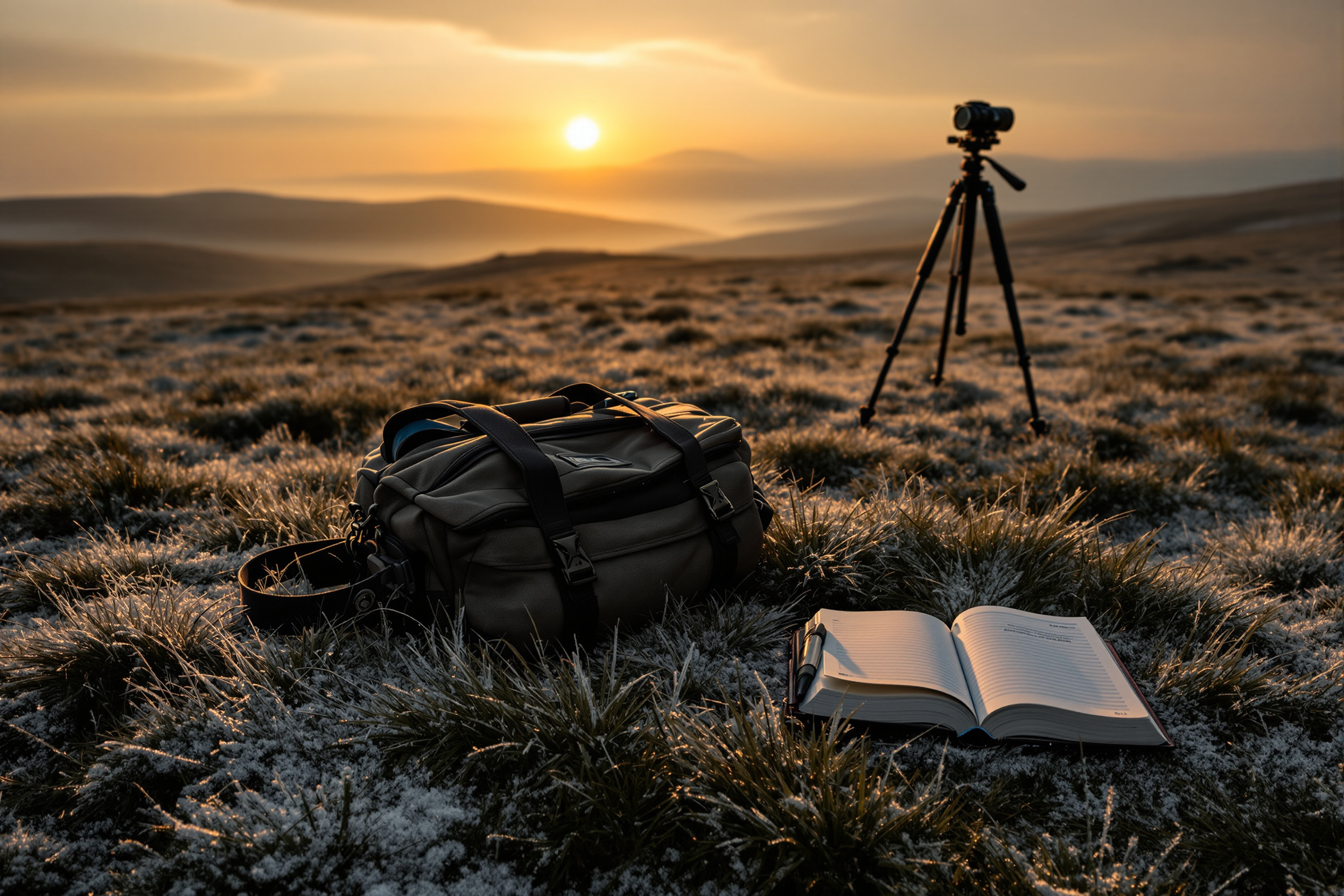
A field load hurts for several overlapping reasons: total mass, where that mass sits, how evenly it is shared, and how long it stays on the body between rests. A compact bag riding high and close usually feels steadier than the same weight swinging low, while a single shoulder strap asks one side to manage every step and scramble.
The last of those — how long the load stays on the body between rests — is also what separates ordinary stiffness after a long day from a shoulder or tendon complaint that keeps returning on later walks. For readers who want to understand what the scientific literature examines, a bibliography of the published research on tissue repair and recovery provides a neutral map of relevant research topics; it is background reading, not guidance for an individual complaint.
The first adjustment is subtraction. Lay the kit out before leaving and give every item a job tied to a likely frame. One body, one versatile lens, a charged spare battery, a card, a cloth and weather protection cover most short walks. A second lens earns its place only when the planned subject truly needs a different angle of view. Small items matter in aggregate: duplicate accessories, oversized chargers and just-in-case tools quietly become another kilogram. Weighing the packed bag once replaces guesswork with a useful number.
The next adjustment is distribution. A pack with two shaped shoulder straps and a waist belt spreads the load across the torso and hips; a sternum strap stops the shoulder straps drifting outward. Tighten the system so the bag stays close without restricting breathing, and place dense items near the middle of the back rather than in an outer pocket. A proper camera harness can work for quick access, provided both sides share the weight and nothing swings into rocks or railings.
Carry the tripod as a separate decision, not as permanent ballast hanging from one shoulder. If the viewpoint is fixed for a while, set it down completely before changing lenses or waiting for light. When moving, collapse and secure every section, then use the pack's centred attachment points for short distances. On uneven ground, carrying it in one hand may be simpler because the hand can swap sides frequently. A tripod slung loose across the back acts like a lever, shifts the bag off centre and catches vegetation.
Finally, treat rests as part of the route. Short, regular stops taken before fatigue changes posture are more useful than one long stop after the shoulders are already tight. Put the pack on the ground, move without the load, drink, and check whether straps have loosened. On the return leg, re-pack rather than stuffing damp layers or unused gear into the easiest pocket. The aim is not to prove how much can be carried, but to arrive at the last frame with enough attention left to compose it.
On the quiet frame
Not every worthwhile picture is dramatic. Some of the most satisfying frames from a season are the quiet ones: fog lifting off a paddock, frost on a fence wire, the last light on a shopfront. These images ask nothing of the viewer and reward a second look. Making room for them — resisting the urge to chase only the spectacular — keeps a body of work honest and human.
On keeping the files in order
Field work is only half the job; the other half happens at the desk, and it is easy to neglect. A simple, consistent habit — dating folders, adding a few words of location and context, and backing up before deleting anything — turns a chaotic drive into a resource that is still usable years later. An unlabelled photograph loses half its future value the moment the memory of it fades. The photographers whose work survives are almost always the ones who were quietly disciplined about naming and storing it.
More craft reading
For the underlying technique behind these notes, see the field guide to light and composition and the guide to landscapes of the New England Tablelands.