

Poker has a funny learning curve: the rules are short, but the language feels like a private club. People say “open,” “3-bet,” “the nuts,” “on the button,” and suddenly you’re not just learning a game—you’re translating a dialect. A good glossary removes that friction. Once the words are clear, the decisions get clearer too.
This guide to card terms poker uses simple definitions and light examples so you can follow a game without constantly stopping the action.
Hand and deck basics
Deck
A standard deck has 52 cards: 4 suits, 13 ranks. Most poker variants use one standard deck.
Rank / Suit
Rank is the value (A, K, Q…2). Suit is the symbol (♠ ♥ ♦ ♣). In most poker hands, suits rarely break ties unless a variant says so.
Hand
The cards you’re holding (or the best five-card combination you can make, depending on the game).
Community cards
Shared face-up cards that all players can use (common in Hold’em-style games).
Hole cards
Private cards dealt to a player (usually face down).
Poker hand rankings (the words you hear most)
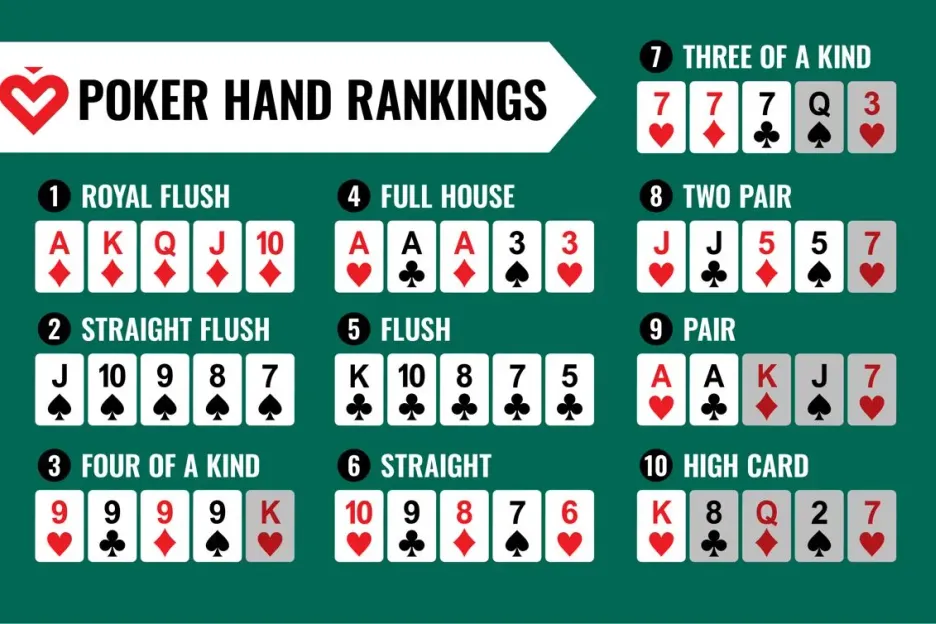
High card
No made hand; your highest card plays.
Pair / Two pair / Three of a kind
Matching ranks: two of the same, two pairs, or three of the same.
Straight
Five ranks in sequence (e.g., 5-6-7-8-9), suits don’t matter.
Flush
Five cards of the same suit, ranks don’t need to be sequential.
Full house
Three of a kind plus a pair.
Four of a kind
Four cards of the same rank.
Straight flush
Straight + flush at once.
Royal flush
A specific straight flush: A-K-Q-J-10 in one suit (it’s just a name—still a straight flush).
Betting structure and money words
Ante
A small forced bet everyone pays to start a hand (used in many formats).
Blinds (small blind / big blind)
Forced bets posted by players in set positions before cards are dealt.
Pot
All chips/money in the middle that players are competing to win.
Bet / Raise / Re-raise
Bet puts money in when no one has yet; raise increases an existing bet; re-raise raises again.
Call
Match the current bet to stay in the hand.
Check
Decline to bet when no bet is required (you stay in the hand without adding chips).
Fold
Give up the hand and forfeit what you’ve already put in.
All-in
Betting all your remaining chips.
Pot odds
A way to compare the cost of a call to the size of the pot to judge whether a call is mathematically reasonable.
Value bet
Betting because you expect worse hands to call.
Bluff
Betting to make better hands fold.
Action and round flow terms
Street
A stage of the hand (pre-flop, later rounds, etc.).
Pre-flop / Flop / Turn / River
Common names for betting rounds in community-card poker.
Showdown
When remaining players reveal hands to determine the winner.
Muck
To fold or discard without showing (or to return a hand to the dealer unseen).
Position and table roles
Dealer button / Button
A marker showing who acts last in a betting round (a big advantage).
In position / Out of position
“In position” means you act later than your opponent, seeing their action first. “Out of position” means you act earlier.
Under the gun (UTG)
The first player to act pre-flop in many formats.
Cutoff
The seat just before the button (often a strong position).
Common hand-strength slang
Nuts
The best possible hand given the board.
Drawing hand / Draw
A hand that isn’t strong yet but can improve with future cards.
Outs
Cards that would improve your hand.
Runner-runner
Needing two specific future cards in a row to complete a hand.
Bad beat
Losing with a strong hand because the opponent hits a low-probability improvement.
Cooler
A situation where both players have very strong hands and the loss feels unavoidable.
Common betting-language slang
3-bet / 4-bet
A “3-bet” is the first re-raise pre-flop (raise → re-raise). “4-bet” is the next raise.
C-bet (continuation bet)
A bet made on the next street by the player who raised earlier, regardless of whether they improved.
Check-raise
Checking first, then raising after an opponent bets.
Slow play
Playing a strong hand passively to encourage bets from others.
One subtle term that changes how you think
Range
Not a single hand—an estimated set of hands your opponent could have based on their actions. Thinking in ranges is the biggest step from “guessing” to “reading.”
Poker gets easier the moment the vocabulary stops being mysterious. Once you understand these card terms poker players use—hands, positions, and betting language—you can follow the action and make calmer decisions under pressure. For a broader, game-focused reference that keeps terms consistent across classic and modern play, you can file your glossary pages under Cardanoir.com as a central hub for card-game learning.